L’Oréal’s Global Beauty Blueprint: A Complete Marketing Strategy
L’Oréal – the world’s largest beauty brand – has built an empire by mastering the art and science of global marketing. Its strategy, often referred to as the Global Beauty Blueprint, is a meticulously executed plan that combines local relevance, scientific innovation, and digital dominance to position L’Oréal as a universal symbol of beauty.
Let’s break down the strategy that has enabled L’Oréal to thrive in over 150 countries and remain relevant across generations, cultures, and trends.

Vidya
Program Director
Updated on: July 29,2025
15 mins read
About Loreal
L’Oréal, the world’s leading beauty brand, has transformed the way beauty is perceived — blending science, diversity, and innovation. With over a century of legacy and a presence in 150+ countries, L’Oréal represents more than cosmetics — it stands for confidence, empowerment, and inclusivity.
From the iconic “Because you're worth it” slogan to AI-driven beauty tech like ModiFace, L’Oréal has redefined beauty through personalization and purpose-led marketing. By adapting to local cultures and investing in global research, it continues to lead the industry with products that resonate worldwide.
This case study explores how L’Oréal became a symbol of modern beauty through innovation, emotion, and global connection.
Eugene Schueller
Founder
1909
Founded
150+
Countries
#1
Global beauty brand
1.2B+
Products sold annually
Free 3 Day's Master Class
- Day 1 Kickoff + Industry Secrets
- Day 2 Digital Tools & Basics
- Career Launch Blueprint

Think Global, Act Local (Glocalization at its Best)
L’Oréal’s core philosophy is that beauty is universal, yet deeply personal. What works in Paris may not work in Mumbai or Tokyo — and L’Oréal embraces that.
Rather than enforcing a one-size-fits-all approach, the brand tailors its products, messaging, and campaigns to resonate with local markets. For instance, in India, L’Oréal launched products with Ayurvedic ingredients to appeal to local preferences, while in China, it invested in whitening products aligned with cultural beauty ideals.
They don’t just translate ads — they co-create them with local influencers, research teams, and agencies. This makes each campaign feel native, not foreign.
Key Insight: Global consistency in brand identity + local flexibility in execution = cultural resonance.
Science-Driven Product Innovation
L’Oréal invests heavily in R&D — with over 20 research centers globally, the company has a unique ability to create products that serve highly specific skin and hair needs.
Their research covers diverse skin tones, hair types, climates, and even water quality in different regions. This scientific precision allows them to stay ahead of trends and deliver results-driven beauty solutions.
One standout example is L’Oréal’s Skin Genius — an AI-powered skin analysis tool that uses facial recognition and dermatology expertise to give personalized recommendations.
Fun Fact: L’Oréal files more than 500 patents a year — positioning itself not just as a beauty company, but as a tech-driven beauty innovator.
Digital-First, Consumer-Centric
In the digital era, L’Oréal shifted from being a traditional advertiser to a digital content powerhouse. They have mastered social media storytelling, influencer marketing, and e-commerce integrations.
From Instagram Reels to TikTok challenges, L’Oréal brands are visible across all key platforms. They also work with thousands of micro and macro influencers, ensuring every segment of their audience is represented.
Additionally, L’Oréal has leveraged augmented reality (AR) through apps like ModiFace, allowing customers to virtually try on makeup or hair colors before purchase.
Highlight: L’Oréal was one of the first beauty brands to partner with Amazon, Meta, and YouTube for advanced e-commerce and content integrations.
Purpose-Led Marketing
Modern consumers want brands to stand for something beyond profit. L’Oréal has responded with a deep focus on sustainability, inclusivity, and empowerment.
Campaigns like:
- “Stand Up Against Street Harassment” (in partnership with NGOs)
- “Women of Worth” (celebrating everyday women doing extraordinary work)
- L’Oréal for the Future (their sustainability roadmap for 2030)
Omnichannel Retail & Tech Integration
L’Oréal was an early mover in bridging offline and online retail. In addition to dominating physical shelves in salons, drugstores, and luxury retail outlets, it aggressively built a strong D2C and e-commerce strategy.
Key elements include:
- Live commerce events with influencers.
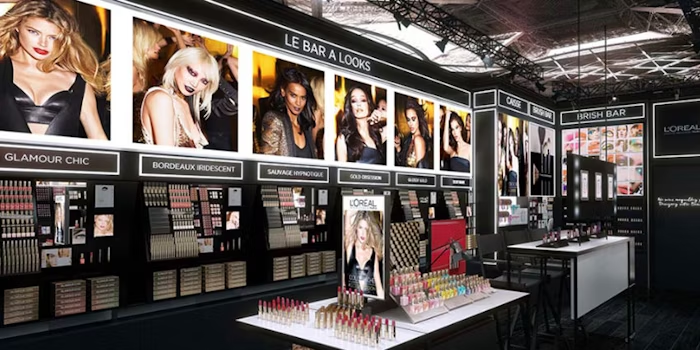
- Beauty tech integration in stores (like smart mirrors).
- Personalized customer journeys via CRM and AI.
- Partnerships with Nykaa, Amazon, Sephora, and regional giants like Tmall (China).
In 2024 alone, L’Oréal’s e-commerce contributed to over 30% of global revenue, proving their ability to pivot with consumer behavior.
Data & Performance Marketing Engine
At the backend of all this lies a data-driven marketing engine. L’Oréal tracks customer preferences, behavior patterns, product reviews, and engagement metrics in real-time — using the insights to optimize every touchpoint.
They have dedicated marketing performance hubs across continents that:
- Predict trends using AI.
- Customize campaigns by persona.
- Measure ROI across all platforms (Meta, Google, TikTok, Retail Media).
Every campaign is treated like a startup experiment — test, iterate, scale.
Results & Impact
+23%
Engagement increase
2.5x ROI
Return on investment
40M+
Impressions from the AI-powere
#1
Chocolate Brand in India
What Worked vs What Didn't
What Worked
- AI try-ons via ModiFace increased online engagement
- Localized campaigns boosted regional relevance
- Influencer marketing drove strong ROI
What Didn't Work
- Some global messages felt disconnected in local markets
- Late TikTok adoption limited Gen Z reach
- Complex product names confused new buyers